
Introduction
If you’re a small business owner, you don’t need more “marketing tasks.” You need a partner that creates measurable growth without consuming your time. That’s the real difference between an average agency and a top digital marketing agency for small businesses. The best agencies don’t just post content, run ads, or “do SEO.” They build a structured marketing system that produces qualified leads, strengthens brand trust, and improves performance over time.
This guide breaks down the exact criteria that define a top digital marketing agency for small business, how to spot the red flags early, and the questions you should ask before signing any agreement. If you want to explore Larimar Digital’s strategy-first approach, start at the Home Page on larimar.digital.
What “Top” Means for Small Businesses
- Generate qualified leads consistently
- Reduce wasted spend and busywork
- Improve conversion rates across your website and campaigns
- Build compounding visibility through SEO and content
- Create a repeatable process you can rely on month after month
- Most importantly, a top agency makes marketing easier to manage, not harder.
The 12 Criteria That Define a Top Digital Marketing Agency for Small Business
1) They Start With Business Outcomes, Not Services
- What is your highest-margin service or product?
- What is your average sale value or lifetime value?
- What locations matter most?
- What does a qualified lead look like for your team?
- What is your close rate today?
- How do leads currently come in, and where do they drop off?
- This is how strategy gets built properly.
2) They Can Explain the Strategy in Plain Language
- Positioning: why your business is the best choice
- Channel plan: where to focus first and why
- Messaging: what to say to attract the right buyer
- Conversion path: how traffic becomes leads
- Measurement: how success will be tracked and improved
- If the plan sounds impressive but unclear, it will be hard to execute and even harder to measure.
3) They Prioritize High-Leverage Work and Say “No” Often
Small business marketing fails when everything becomes a priority. A top digital marketing agency focuses on leverage: the few actions that change the outcome.
- Fixing a confusing homepage message that lowers conversion
- Creating dedicated service pages that can rank and convert
- Cleaning up tracking so ad optimization is based on real conversions
- Building a review system that improves trust and local visibility
- Publishing content that answers buyer-intent questions and supports service pages
- Top agencies protect your budget by refusing to do low-impact busywork.
4) They Understand the Full Growth System, Not Just One Channel
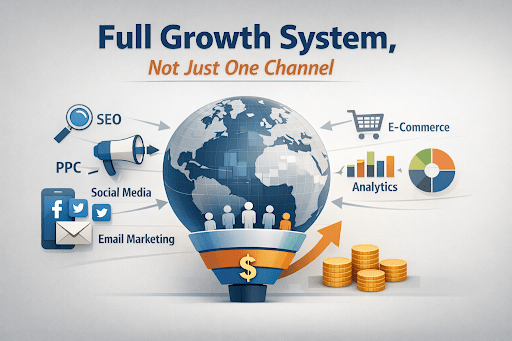
A digital marketing agency for small business should understand how the core system connects: website, SEO, ads, social, tracking, and follow-up. You don’t need to buy everything at once, but your agency must understand the whole machine so you don’t scale a weak foundation. A common failure pattern looks like this: run ads to a weak website, track the wrong conversions, and conclude “ads don’t work.” The issue is the system, not the channel.
5) They Treat Your Website Like a Conversion Asset
- Clarity of your offer and messaging
- Service page structure and internal linking
- Mobile usability and speed
- Trust signals near calls-to-action
- Forms, booking flows, and click-to-call functionality
- If a marketing agency never talks about your website conversion rate, they are missing the core asset that every channel depends on.
6) They Build SEO the Right Way for Small Businesses
- A revenue-first page structure (one page per core service)
- On-page SEO that matches buyer intent
- Local SEO alignment (Google Business Profile plus website support)
- Content that supports service pages, not random blog volume
- Measuring leads from organic search, not just rankings
- If you only have one generic services page, a top agency will flag that immediately and propose a structure that can actually rank and convert.
7) They Run Paid Ads With Measurement and Control
- Clean conversion tracking (calls, forms, bookings)
- High-intent targeting and negative keyword strategy
- Landing pages that match ad intent
- Consistent creative and message testing
- Reporting that ties spend to qualified leads and cost per acquisition
- If an agency optimizes ads based only on clicks and impressions, you’re paying for activity, not outcomes.
8) They Create Content That Supports Buying Decisions
- Pricing and cost factors
- What to expect when hiring a provider
- Process and timelines
- Comparisons and decision guides
- Case studies and before/after results
- Local relevance when it matters
- A top agency uses content as a sales asset, not a filler task.
9) They Report Like Business Partners, Not Platform Operators
- Leads generated and lead quality trends
- Cost per qualified lead for ads
- Conversion rates by landing page or service page
- Organic traffic and rankings for revenue-driving pages
- What changed this month and why?
- What happens next and what will be tested or improved
- If your report is only charts and platform screenshots, you will struggle to understand ROI.
10) They Have a Clear Process That Protects Momentum
- Monthly planning and priorities
- A content calendar tied to buyer intent
- An approval process that is efficient
- Defined deliverables and timelines
- A feedback loop from reporting to optimization
- If you feel like you’re constantly chasing updates, the process is broken.
11) They Make Ownership and Access Non-Negotiable
- Your domain and website admin
- Google Analytics and Search Console
- Your ad accounts (Google, Meta, LinkedIn if used)
- Your creative files and content library
- Your business listings (Google Business Profile)
- If an agency insists on owning accounts “under their umbrella,” you risk dependency and data loss if you ever switch providers.
12) They Set Real Expectations and Communicate Honestly
Ads can produce early results faster, but need tracking and landing page alignment.
SEO compounds over time and requires consistency.
Better results often require improvements to offer clarity, proof, and follow-up speed.
An honest agency will tell you what they need from you and what will slow results if it’s missing.
Questions to Ask Before You Hire a Digital Marketing Agency
- What would you prioritize in the first 30 days and why?
- How do you define and measure a qualified lead for my business?
- How will you connect marketing performance to calls, inquiries, and booked appointments?
- What does your reporting look like, and what decisions should it drive?
- How do you approach website conversion improvement alongside SEO and ads?
- How do you structure SEO for service pages and local visibility?
- How do you prevent wasted ad spend from low-intent searches or audiences?
- What do you need from me to succeed, and what happens if approvals are delayed?
- Who owns the accounts and assets at the end of the engagement?
- A top agency will answer clearly, directly, and with a structured plan.
Common Red Flags That Signal You Should Walk Away
- Guaranteed #1 rankings on a fixed timeline
- Vague deliverables like “SEO work” or “marketing support”
- Reporting that focuses on vanity metrics, not leads
- No discussion of tracking and conversion measurement
- No mention of landing pages or website conversion
- Heavy emphasis on backlinks or “secret tactics”
- No clear process for approvals, timelines, and accountability
- Refusal to provide access to accounts and assets
- If you see two or more of these red flags, keep looking.
What Success Should Look Like in the First 90 Days
A top digital marketing agency for small business will usually operate in phases:
Days 1–30: discovery, baselines, tracking validation, priority fixes, strategy roadmap, quick wins.