
Introduction
For most small business owners, marketing is not the hard part. Consistency is. You can have a great service, strong referrals, and a solid reputation, but still feel stuck because your marketing depends on “when you have time.” That usually means marketing happens late at night, between client calls, or not at all. Over time, that inconsistency creates an invisible ceiling: lead flow becomes unpredictable, growth becomes reactive, and you end up relying on referrals alone even when you want to scale.
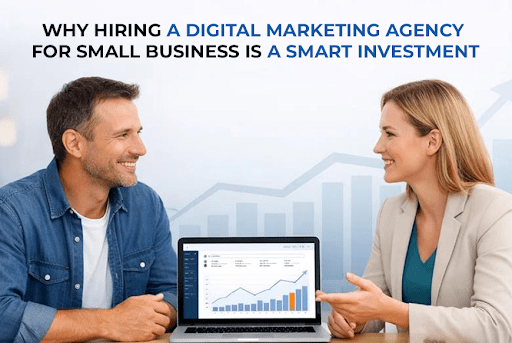
That’s why hiring a digital marketing agency for small business is often a smart investment when you choose the right partner. You’re not paying for random activity. You’re paying for a repeatable system that builds visibility, improves conversion, and creates qualified demand without consuming your time. This blog breaks down what “investment” really means, how to evaluate ROI in plain language, and what to expect from a best online marketing company in the first 90 days.
What “Investment” Actually Means in Small Business Marketing
An expense is something you pay for and it disappears. An investment is something you fund because it creates a return or builds an asset that keeps working. In digital marketing, those assets are not just “content.” They include:
- A clear website structure that turns visitors into inquiries
- Service pages that rank and convert
- A Google Business Profile that drives calls from local search
- Content that answers buyer-intent questions and builds trust
- A paid ads system that can scale without wasting spend
Tracking and reporting that show what is producing leads
When a marketing effort builds these assets, it compounds. The work you do this month makes next month easier. That is what separates an agency investment from paying for marketing tasks that reset every month.
The Real Cost of Doing Marketing Alone
Most small business owners initially do their own marketing because it feels like the responsible thing to do. But the cost is not always your credit card bill. The cost is time, stress, missed opportunities, and slow learning.
- Common “hidden costs” include:
- Inconsistent posting and content because client work comes first
- Random marketing decisions based on guesses, not data
- Ads run without proper tracking, so optimization is blind
- A website that looks professional but does not convert
- No steady review system, so local trust signals stay weakDelays between “we should do this” and actual implementation
- Burnout from constantly switching between operations and marketing
Even if you are talented, the owner’s attention is the most expensive resource in the business. When marketing consumes it, growth often slows instead of accelerating.
Why an Agency Can Outperform a Single Hire
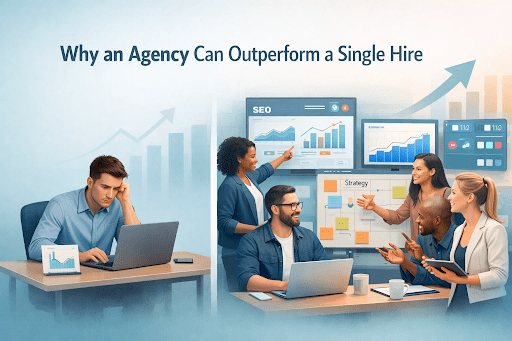
Hiring in-house can be an excellent move, but many small businesses are not ready to build an internal marketing department. One person rarely has expert-level ability across strategy, SEO, ads, web conversion, content planning, design, and analytics. Most end up being a generalist, and the business still has gaps.
A digital marketing agency for small business typically provides a team skill set without the overhead of hiring multiple roles. A strong agency brings:
- Strategy and prioritization so your effort stays focused
- Execution across multiple channels without fragmentation
- Specialized knowledge in SEO, ads, conversion, and creative
- A repeatable workflow and timeline discipline
- Performance reporting so decisions are tied to outcomes
This is why an agency can be a faster path to ROI than “hiring one marketing person and hoping it works.” You are buying a system that already exists, not building one from scratch.
The Compounding Effect of Integrated Marketing
A best online marketing company doesn’t treat channels like separate projects. They build a single system where each part supports the others.
Here’s how compounding happens in real life:
- Your website messaging improves, so more visitors become leads
- Your service pages get optimized, so organic traffic increases over time
- Your blog content supports those service pages, strengthening rankings
- Your Google Business Profile becomes active and credible, driving calls
- Your ads send traffic to the right landing pages, improving conversion
- Your reporting identifies what works, so budget shifts to the winners
When marketing is integrated, you stop paying repeatedly for disconnected tactics. You build an ecosystem where results improve month after month.
What a Smart Agency Investment Should Produce
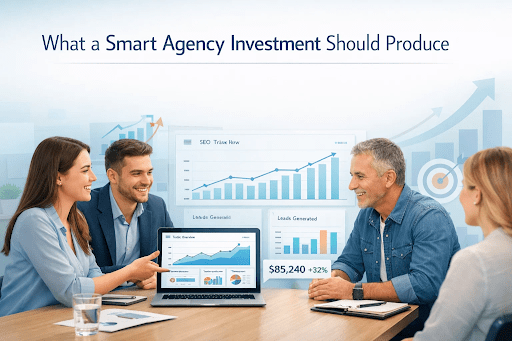
You should be able to point to clear outputs and clear outcomes. Both matter.
Outputs you should expect:
- A prioritized plan for the first 30–90 days
- A clear content strategy tied to buyer intent
- Website and conversion improvements on key pages
- Campaign structure for any paid ads with proper tracking
- Ongoing reporting with next steps, not just numbers
Outcomes you should expect to begin improving:
- More qualified leads, not just more traffic
- Better lead quality because messaging and targeting improve
- Higher website conversion rates because the site becomes clearer
- Lower wasted spend due to tracking and optimization discipline
- Improved visibility for your revenue services through SEO and local search
- If an agency can’t define what success looks like and how they will measure it, the relationship becomes subjective. A true investment is measurable.
A Simple ROI Framework Any Small Business Can Use
You do not need complex dashboards. You need four numbers and a consistent review habit.
Track:
- Monthly marketing cost (agency fee plus ad spend if applicable)
- Qualified leads generated (not raw inquiries)
- Close rate (percentage of qualified leads that become customers)
- Average revenue per customer (or gross profit per customer)
Example:
- Monthly marketing cost: $2,000
- Qualified leads: 25
- Close rate: 20% (5 customers)
- Average revenue per customer: $1,500
- Revenue from marketing leads: $7,500
- Then compare it to your cost and refine based on gross profit and lifetime value.
- This approach keeps ROI practical. It also forces the agency to focus on lead quality and conversion, not vanity metrics.
What Should Happen in the First 90 Days
A results-focused agency should operate in phases.
Days 1–30: Foundation and clarity
- Discovery, goals, and lead definition
- Tracking checks so calls, forms, and bookings are measurable
- Website messaging and conversion quick wins
- SEO baseline and service page priorities
- Plan for content, local SEO, and any paid campaigns
Days 31–60: System building
- Service page optimization and internal linking improvements
- Content plan execution tied to buyer intent
- Google Business Profile improvements if local search matters
- Paid campaign structure and testing if ads are included
- Reporting that shows early signals and what is being improved
Days 61–90: Refinement and momentum
- Better targeting and messaging based on performance data
- Landing page conversion improvements
- Reduction of wasted spend through search term refinement and negatives
- Stronger trust signals: reviews, proof content, case studies, visuals
- Clearer trendlines for lead quality and cost per qualified lead
By day 90, you may not be “done,” but you should have a system that is clearly improving and a plan that gets sharper with data.
When Hiring a Digital Marketing Agency Might Not Be the Right Move
A good agency will tell you when timing is wrong. It may not be the right move if:
- Your offer is unclear and you can’t articulate what you sell quickly
- You cannot handle additional leads operationally
- You are not willing to provide approvals or basic inputs consistently
- You refuse to measure leads properly, so optimization has no data
- Your margins cannot support customer acquisition costs
- In those cases, a strategy and foundation phase is often the best first step. It builds the clarity and infrastructure needed for ongoing growth.
How to Choose the Right Agency Partner
If you want this to be a smart investment, evaluate the agency the way you would evaluate any growth partner.
Look for:
- Strategy-first thinking and clear priorities
- A process that reduces your workload instead of increasing it
- Conversion tracking and lead quality measurement
- Integrated thinking across website, SEO, content, and ads
- Transparent reporting that ties to leads and business outcomes
- Ownership and access to your accounts and assets
- Realistic expectations and honest communication
Avoid:
- Guaranteed #1 rankings on a fixed timeline
- Vague deliverables like “SEO work” with no breakdown
- Reporting that only shows impressions, clicks, or followers
- Ads run without landing page alignment and tracking
- A dependency model where the agency owns your accounts
How Larimar Digital Approaches Small Business Growth
Larimar Digital supports growth-minded small businesses that want clarity, consistency, and measurable outcomes. Our approach is strategy-first and execution-focused, designed to build a marketing system that produces qualified leads while giving you your time back. If you want to learn more, visit the Home Page on larimar.digital and use View Pricing and Packaging when you’re ready to explore options.
FAQ
1. Is hiring a digital marketing agency worth it for a small business?
Yes when the agency focuses on measurable outcomes, improves your conversion system, and reports performance in terms of qualified leads and ROI, not just activity.
2. What matters most when evaluating a best online marketing company?
A clear strategy, tracking discipline, reporting tied to leads, and the ability to prioritize high-impact work instead of doing random tasks.
3. How long does it take to see results?
Paid ads can show early results faster once tracking and landing pages are aligned. SEO compounds over time and typically becomes more cost-effective as your service pages and content build authority.